



 🖨️ Print post
What happens when what we believe—and what we actually do—don’t quite line up?
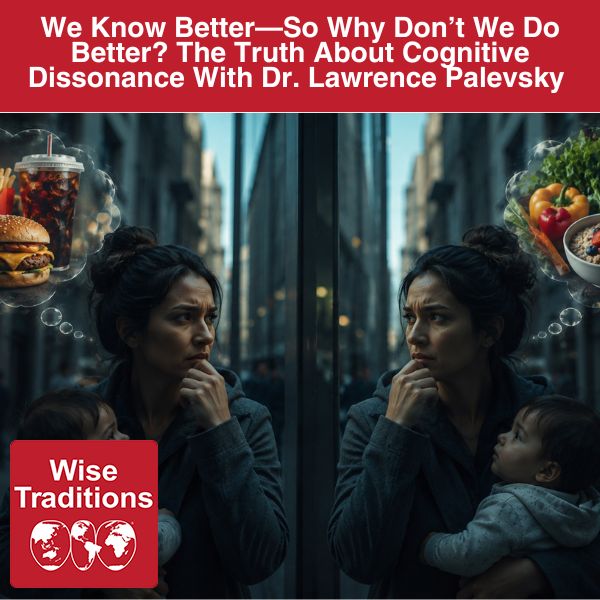
This week on the Wise Traditions podcast, pediatrician Dr. Lawrence Palevsky explores the concept of cognitive dissonance—what it is, why it’s so common in modern life, and how it quietly shapes decisions around health, parenting, and trust in authority.
Dr. Palevsky has spent decades encouraging parents to think critically, ask better questions, and reconnect with their own intuition. In this episode, he explains how cognitive dissonance shows up in everyday choices—from the foods people eat to the medical decisions they make—and why it can be so difficult to reconcile conflicting beliefs, even when the stakes are high.
The conversation examines the tension many feel between what they’ve been told is “safe” or “normal” and what they instinctively sense may not be right. Dr. Palevsky discusses how fear, conditioning, and social pressure can keep individuals stuck—and what it takes to step outside that framework and begin thinking independently.
This episode offers a thoughtful look at awareness, responsibility, and the courage to question long-held assumptions. It serves as an invitation to slow down, examine inherited narratives, and consider what it truly means to make informed, conscious choices for oneself and one’s family.
WAPF Ad- 11 principles book – Westonaprice.org and click on the “order material” button
Visit Dr. Lawrence Palevsky’s website to learn more
Join the Nourishing Our Children closed Facebook group
Check out our sponsors: Goddess Vitality from Optimal Carnivore “Discount code WESTON10 for 10% off” and New Biology Clinic, “Discount code WISETRADITIONS”
—
Watch the episode here
Listen to the podcast here
Episode Transcript
Within the below transcript the bolded text is Kendall Nelson
What if the gap between what we know and how we actually live is at the root of so much of our modern health crisis? We all say we want to be healthy. We want the best for our children. We want to make good choices. Yet day after day, we find ourselves doing things that don’t fully align with what we believe to be true. This is episode 578, and our guest is Dr. Lawrence Palevsky. In his decades of pediatric practice, Dr. Palevsky has seen just how powerful and how consequential that gap can be. He calls it cognitive dissonance, the space between awareness and action.
In this conversation, we explore how that disconnect shows up in the most personal parts of our lives. From the foods we feed our children to the way we parent to the culture we’re raising them in. Dr. Palevsky shares stories from his practice that reveal how small everyday choices can have profound effects on a child’s health and development, and why some of the hardest changes for parents may also be the most important.
We also talk about addiction, not just to food, but to comfort, distraction, and even negativity, and what it really takes to raise resilient, independent, and emotionally grounded children in a world that often pulls us in the opposite direction. This is a conversation about awareness, responsibility, and ultimately, about returning to a more conscious way of living.
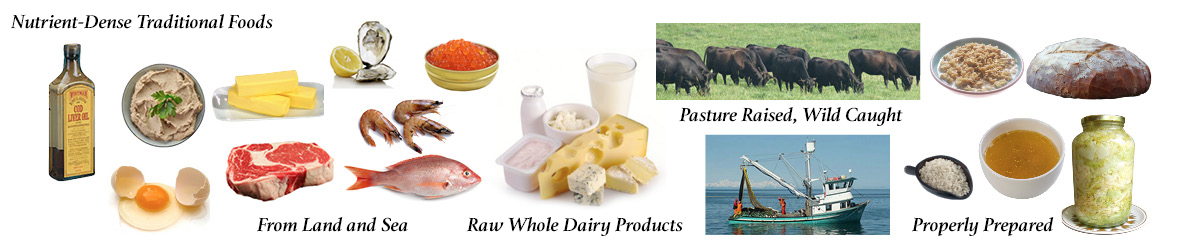
Before we get into the conversation, I want to tell you about a book by the Weston A. Price Foundation that highlights eleven dietary principles based on healthy, traditional diets. This book gives an overview of how to eat more ancestrally. Whether you have dietary restrictions because of sensitivities or not, there’s something in each chapter that you can implement for better health. It’s only $10 or $5 if you place a bulk order of 10 or more. Go to WestonAPrice.org and click on the Order Material button on the home page to find this important 11 Dietary Principles book.
—
Larry, welcome to Wise Traditions.
Kendall, thanks for inviting me. It’s good to be here.
Understanding Cognitive Dissonance
It’s so good to have you here. It’s been this is déjà vu. It’s been a long time since we sat down for an interview when we interviewed you for our movie, The Greater Good. This is very exciting for me, and anyways, we’ve been friends this whole time and I’ve been following your work. I know that one of the things that you talk about a lot is the idea of cognitive dissonance. I see this as the gap between what we understand and what we believe to be true, and how we actually live our lives day to day. I’m really interested in having you explain the definition and then talking to me a little bit about it and what it means in terms of health.
Kendall, I think it was 2007 that we did the interview for The Greater Good. Somewhere in 2008, somewhere along in there. Back in the late ‘90s, when I was running a pediatric intensive care unit at a hospital in New York City, I was standing in the intensive care unit and a pediatric gastroenterologist came into the unit to see a patient. He was so excited and I said, “Bill, what are you so excited about?” He said, “We just came out with a drug that’s going to help to stop inflammation in kids with inflammatory bowel disease.”
When he started talking about it, I knew what the drug was, and I let him talk, and I said to him, “Bill, those chemicals that the drug is now going to block are actually produced from the fats that we eat in our diet and the sugars that we eat in the diet. If we just lowered the pro-inflammatory fats in the diet, you wouldn’t need the drugs. You can actually help the kids with inflammatory bowel disease just by changing their diet.” He was sitting in a chair, he looked up at me and he went right back down into his chart and kept writing.
I thought, “You’re going to block these leukotrienes,” which are the name of the chemical. You’re going to block them but not stop the patient from producing them that would cause the inflammation.” The chemicals of inflammation are still going to go somewhere. Of course, in the last 30 years, we’ve seen that there are neurological symptoms that happen to kids when they take these drugs.
You suppress the inflammatory chemicals from going out the gut and then they go deeper into the body and go into the brain. There’s the first real sign of cognitive dissonance. We’re going to give you a drug so that the chemicals that produce inflammation that give you inflammatory bowel disease won’t hurt you, but we’ll ignore the fact that you can stop producing them just by changing your diet.
I would guess that in your practice, you see the idea of cognitive dissonance a lot regarding food and changing just some simple habits food-wise. Tell me a little bit more about what you see.
I’ll look at a kid when I take a history of a child and I do the diet history, I just listen. I’ll ask different food groups. “Do you eat this?” All of a sudden, the child and/or the parent would say, “Yeah, my child loves that.” I know that that’s not the brain talking, that’s addiction talking. I know that there’s a good chance that that food is probably hurting the kid.
I’ll say to the kid, “All right, so if I told you that tomatoes were hurting your health, would you stop them?” “Yeah, sure, no problem.” “All right, if I told you cucumbers were hurting your health, would you stop them?” “Yeah, no problem.” “All right, if I told you to take gluten out of your diet, would you take it out if you knew it was going to help your health?” “Absolutely not. No way.” The body speaks before the brain does.
The body speaks before the brain does.
It’s very hard to show parents because a lot of times, kids are loving the foods that are not good for them and not eating anything else. If I say, “It’s best to take that food out of your diet,” the parent looks at me and says, “What is my kid going to eat?” I have to go through this whole explanation of how the foods that your children are eating that they can’t stop eating are blocking their appetite to eat other foods because you’re actually creating these morphine-like reactions with these foods.
What heroin addict eats? They don’t. It becomes this effort to try to undo the addictions and undo the cycles of, “As a parent, I need to get my kid to eat. My kid won’t eat, this is all my kid will eat, but I’m doing the shopping and I’m doing the cooking and yet I’m giving my kid the food that my kid will only eat, but if I take that food away, my kid won’t eat anything.” It’s a round robin of difficulty.
Why We Should Stop Children From Eating Unhealthy
This really comes down to parenting in a lot of ways too, because it sounds as though some of the parents you see in your practice are afraid to disappoint their child. I can’t imagine why any parent would rather have a sick child than say no to their child, but what do you see?
I think we have to remember that if a parent is coming to me, they are dealing with a lot of chronic illness in their children and so they’ve been through a lot. They’re in fight or flight most of the time. As we know in the American culture, we’ve accepted ease and taking the path of least resistance. Fast foods, processed foods, frozen dinners, all the things that make it easier rather than to sit and stand in the kitchen and cook, which again, I get the battle that parents have.
When I ask parents to remove a food because I think it’ll help, it really sends this signal of overwhelm. Remember, if you have a family with a child with a chronic illness and you’re following the standard medical care, it’s hard. This drug, then another drug, then another drug, then another therapy and another drug. When I make my recommendations about changing the food, the parents look at me and say, “This is hard.” I say, “You’re right, but it’s hard either way, either path you take.”
The question is which path is hard with a light at the end of the tunnel and which path is hard with the potential of no light at the end of the tunnel. A while ago, I had a child who was thirteen months old and flapping his hands and looking out the sides of his eyes and not babbling, and he was completely clean, he had not had any vaccines. I looked at the parents, and I said, “I think your child is reacting to the milk you’re giving him. Please remove it and let’s see if things change.” Now, this is not based on a knee-jerk reaction, this is based on decades of experience, like I’ve seen this before. I saw the kid back nine months later. He was 21-22 months and he was worse.

He was flapping a lot and his eyes were to the side and he was in his own world, you could see this glaze over his eyes. I said, “What’s going on guys? Did you get rid of the dairy?” “No, we’re trying.” I said, “Trying? Who’s in charge?” “He gets so upset. We don’t know what we’re going to do when he doesn’t get the bottle.” I said, “Yes, that’s the sign that he’s addicted and that’s the perfect sign that we need to parent him and not give it to him.”
This is an indication of a child who has a parent who needs to do what’s in the best interest of the child, not what’s in the child wants. They felt defeated. I’m like, “Guys.” The mother looked at me and said, “Yeah, you told us to do that nine months ago.” I said, “Yeah, I did.” Fast forward, the kid came back 4 or 5 months later and he was back to normal. He was starting to talk, he was looking at you, he stopped flapping, he wasn’t in his own world, he was related, he was playing. I said to the parents, “What’d you do?” They said, “Well, we took it out.” I said, “Okay, good.” I looked at the parents, and I said, “You know, it wouldn’t surprise me if your son has something called cerebral folate deficiency.”
There are a lot of children on the neurological spectrum who suffer from cerebral folate deficiency and one of the things that hampers them is dairy. It just does. You can give all the leucovorin you want, but it’s not advantageous for them to be on any dairy. He got better just by removing the dairy because he probably had some mechanism of reaction, sensitivity, intolerance, or even allergy that led to neurological symptoms.
I think we live in a culture, Kendall, where the medical community, the media, the government, the big pharma, big Ag all tell you that your health is unrelated to the food you eat. That’s the biggest cognitive dissonance I’ve seen. A pulmonologist will say to a parent with a kid with asthma, “No, you can eat whatever you want.” The American Diabetic Association will tell people with diabetes, “Yeah, you can eat how much sugar you want and whatever sugar you want, just as long as you check your blood sugars and control your sugars with insulin.”
That’s amazing. They’re doing that obviously to sell drugs, to stay in business?
One might think that that’s probably the case because you have to scratch your head to understand why else they would, because A, not all sugars are alike, and B, your overall health isn’t just what your blood sugar is and how much insulin you can give to maintain your blood sugar because elevated blood sugars can really hurt your health in so many ways.
They can open up your blood-brain barrier, it can hurt your kidneys, it can hurt your heart, it can hurt your nerve endings, it can hurt your blood vessels at the ends of your feet and your hands. To just say, “Oh, it doesn’t matter,” is pretty much malpractice, but people follow it because the American Diabetic Association said it so it must be right and then my doctor says, “Don’t, don’t worry about it, just eat whatever you want, just control your sugar with your insulin.”
Dispelling The Myth Around Cholesterol
This is reminding me of the whole cholesterol myth and selling statins and the idea that they keep lowering the amount of cholesterol that they say is good for your body. What do you think about that?
I was born back in the 1960s, 1961, and I remember early on in my childhood, my early medical school, the normal level of cholesterol for adults was 300. Now, it’s all of a sudden closer to 100. What changed? Heart disease has gone up. Strokes have gone up, cancer has gone up. Alzheimer’s has gone up and Alzheimer’s is also believed to be a type 3 diabetes or at least a type 3 diabetes component. If the statins are helping, I don’t understand why all these health conditions are getting worse as we lower the normal cholesterol and it doesn’t take a brain surgeon to understand how important cholesterol is for the brain.
You need it, and I mean, I think the biggest fallacy was when people were told not to eat eggs because it’ll raise their cholesterol, when in fact, no, that’s not true. Sugars are probably the worst thing you can eat to raise your cholesterol, and really unhealthy fats. We’re back to the whole fat issue. When America went low-fat, it went high-sugar.
With low fat and high sugar, that’s when obesity and heart disease and cancer, and chronic illness just skyrocketed. When kids started getting obese and developing type 2 diabetes, then we see the next layer of GLP-1 drugs and bariatric surgery because people are not allowed to be disciplined. People are not taught to be disciplined. They have to get what they can to make them better without doing things to make them better. That’s hard. That’s really hard.
Fixing The Culture Of Addiction And Enabling
At the root of all this, why do you think it is that people struggle so much with to live in alignment with what is good for us? What is it that inhibits them?
I think there are a couple of factors. One is that we live in a rescue culture. We live in a culture where there’ll always be somebody to save us, there’ll always be somebody to rescue us and so why really take responsibility for it? We don’t have to. We’re enabled. It’s an addiction/enabling rescue, “I’ll save you” culture.
The other part is that the advertising in this country is second to none when it comes to enticing people to buy their products. Most people are not going to look at their products and go, “They’re putting all this stuff in here to make me addicted to it, so I shouldn’t eat it.” No. They’re putting stuff in there to make you addicted so you do eat it and then you don’t have the higher brain centers to say, “I can’t keep doing this to myself.” There are multiple reasons for the condition but I don’t think Big Ag and the food industry is focused on altruistic tendency.
They just want you to buy their product. They know that if you buy their product, you’re going to get sick because they’re not eating those foods but they’re enticing you to eat it. They make it colorful with all the dyes and the preservatives and the additives and the food colorings so it tastes good, but it’s empty in nutrition. When it’s empty in nutrition, it makes you want to eat more because you’re starving for nutrition. Nutrition to the chemicals that make you addicted to it. Most people, they’d hear me say this and they go, “You’re a conspiracy theorist.” Okay, I can only tell you from my experience that that’s true.
You’ve got 30 years in pediatric practice plus a lot of medical experience prior to that, so you would think that people would be pretty apt to listen to you when they come to visit. What’s your success rate? What does the average person do? Do they actually eventually do what you suggest or do you see time and time again that they don’t?
In my current office, I’ve been there 21 years. I would say initially, I probably had about a 40% success rate. Nowadays, I would say I’m closer to maybe 80%-plus success rate. Maybe it’s because of the way I’ve grown or maybe it’s because I have different patients coming, maybe it’s the way I deliver it that’s different, maybe people are just really in need of help and are willing to do the work now. It’s very hard.
When I was a teenager, I worked in a catering hall at weddings and I used to say to my friends there, I said, “You know there are two things people would kill for, one is food and the other is money,” and it’s true. Food is just it’s a driving force and I watch how people are more interested in the soothing from the food than they are the soothing of getting better. It’s hard. Addictions are hard.
I’ve had my own food addictions when I was growing up, I get what it’s like. I used to eat 7, 8 meals a day sometimes, 9 meals. I used to eat sugar like it was water. I just kept eating it. I know the days and then into my adult years, I remember how if I was uncomfortable or if I was not feeling good, sugar because I often say that obesity is a condition of starvation because there’s just so much that’s lacking.
Obesity is a condition of starvation.
There’s so much lacking in the foods that we eat and there’s so much lacking in the in the spirit that’s looking for soothing outside and it’s a process of trying to generate that soothing other healthy ways, constructive soothing versus destructive soothing. I know how hard it is. I do. I know how important it is not to hurt myself and so it’s a progress. It’s a process and there’s a lot of progress that needs to happen for people to get through their addictions and food is a big one. It’s a big addiction.
Why Some People Are Addicted To Negativity
To expand on the addiction thing a little bit, I know you and I have talked before about how it’s not just food that people are addicted to, of course, and we know people are addicted to drugs and things like that but one of the things you said to me that stuck with me was that people are addicted to negativity. Can you tell me a little bit about what you think about that? What are they really looking for?
I’ve done a lot of work on multiple addictions and as I got through layers and layers of some of them, I had one of my teachers once say to me, “You do realize that you use negativity as a way of connecting.” I looked at him and said, “Whoa.” I had to look back on ways in which I never learned connection. I never learned relationship. It wasn’t modeled for me and it was too traumatizing. Relationship was always traumatizing to me.
When I started listening to myself and realizing that I would connect to people by using negative thoughts, negative experiences, if I’m not feeling well, and it was a way for to think that people would connect to me, and what I started realizing was, “I can’t. I have my own stuff, I can’t be around that.” what I realized was that it was attention, but it wasn’t connection. When I started to learn what connection really was, which was I see you and I see me.
I know you’re there, I know I’m here and let’s talk. It just became something very different. Negativity is also an armor, it’s a way of protecting yourself because if you’re negative and you’re connecting negatively, you don’t have to worry about anybody hurting you because you’re keeping yourself protected and in the process of healing start to peel the layers of armor about needing to protect myself.
I started to learn that I could really have valuable relationships, friendships, partnerships where we were not using negativity as a way to connect but we’re using something a lot more heart-centered and filled with light. I don’t say negativity every now and then, but it doesn’t drive my being. It doesn’t drive my day-to-day life.
It’s making me think about how we really just have to be conscious and we have to be wise in our friendships and our relationships and it’s reminding me of when people do bright-siding. You tell them that something is wrong and you’re looking for not as an attention-getter, but as a true means of getting connected and they bright-side you. “Well, at least that terrible thing didn’t happen later in life,” whatever it is. It’s not what we’re really looking for. We’re just looking to connect.
I teach parents a lot of child development and I teach them about connecting to your kid and when you see a child, a toddler who’s crying and the parent does dances through hula hoops to tell the kid, “You’re okay, it’s okay,” and then brings this toy and this toy and that book and that food and that drink. I look at the parent and I say, “You realize that you’re not connecting to your child?”
Of course, like, “What?” it’s like, “No, you’re telling your child who’s crying that she’s okay and your child is telling you she’s not okay, that’s why she’s crying.” we go through this conversation of what it’s like to feel discomfort and teach the nervous system to deal with discomfort so that the child can realize that at the end of it, she doesn’t die. That she can actually withstand discomfort in your presence and get through it and realize that that builds confidence.
It’s like, “I was uncomfortable, I didn’t get what I wanted, I really wanted that. My mom didn’t give it to me. She held my hand, she sat with me, she said to me, ‘I know, sweetie, I know you’re upset, but I can’t give it to you.’ what I realized was that after sitting on her lap, I was okay.” it built a sense of confidence that I could deal with negativity, I could deal with discomfort and I have the love and connection of my mother who’s just sitting there holding the space for me to go through it. That’s what kids really need. What we see is, “You’re okay, don’t cry. We’ll give you this, we’ll give you that.” The kid is like, “Why aren’t you connecting to me?”
Giving Children Enough Empty Space
Exactly. We’re stifling their emotions and it’s similar to when a parent is always trying to entertain their child and they don’t ever allow their child to be bored. Without boredom, you’re never going to be resilient, you’re never going to have creativity. As parents, we’re putting screens in front of our children too or we’re distracting them in any way possible. If a child is watching something on a screen, that’s someone else’s creativity they’re looking at. It’s not their own creativity. I don’t know, it just seems like this whole cell phones, the video games, the social media, the AI. This is all a huge problem. How do you see that?
I’m very concerned about the children of today and their ability to critically think. I’m concerned about their ability to be creative. I’m concerned about their ability to be resilient. I’m concerned about their ability to figure things out and problem-solve. I’m concerned about their ability to not know what they don’t know. What I watch happen is I remember as a kid when I would go to camp or it was a summer night and we would lie out on the fields or lie out in the park bench just look up. Just look up.
We didn’t know what we were looking at but we were just looking up. A thought would come to one of us and then a thought would come to another one of us and then a conversation would start and we’d start connecting. We’d sing a song, we’d play a game, we’d have a revelation, we’d have an inspiration. We’re like, “You know what? Let’s do this.” What I try to teach parents and kids which falls on deaf ears because of the addiction is that creativity, imagination, thought, reason, critical thinking, inspiration, ideas, unknowns, only happen in the empty spaces.
They don’t happen in the full spaces. The fact that the kids are on the devices for so many hours a day and the fact that the parents are on the devices so many hours a day, what ends up happening is the kids never get empty space. You can watch them, like I’ll see kids in my in the waiting room in my office and they’re just locked in. I went to take a say hello to a twelve-year-old who I hadn’t seen in years. I went to say hello to him, and I’m like, “Come on, give me a phone.” He wouldn’t let go of it. Just to say hello because I had to do this.
I said, “Take away the phone, look around you.” I think the fact that we’re not creating empty space. Before the cell phones and the devices and the video games was all the scheduling. This activity and then this activity and then this activity and then the next day, three more activities. Kids were never allowed to be bored. When we were kids, if we were bored, our parents would just kick us out of the room like, “Go do something. Just go figure it out.”
You would never tell your parents you were bored because they might put you to work. You got out of the house and you had your friends and your bike. For me, I had a horse and that was the most magical thing, you know? My pets were my companions and I just had the best childhood because I was never in front of a screen and had a lot of freedom too which was really wonderful.
That’s the thing. The kids don’t have freedom and you can’t imagine anything in life if you’re busy filling your life up with information and stimulation. I look at the kids who are on the devices and they pick up their heads and they’re like this, like fogged and drugged. I literally will look at the parents and I’ll say to them, “I need you to know that this is intentional. This is being done to your kids intentionally.”
It removes the development of the highest part of the brain that distinguishes us as humans from all other mammals. That is the ability to think and reason and concentrate and focus and pay attention and analyze, understand, gain knowledge, and have higher consciousness, greater connection to a higher power. They know. I’m going to say this again, guys. They know that they are stopping the brain from developing because anytime you create an addiction, you stop higher brain development.
Anytime you create constant filling of time and stimulation and activities all the time without downtime, without empty space, without boredom, you fail to develop the higher brain centers. You’re a good soldier who becomes a good follower who does what you’re told and won’t even speak up. I think that the greatest war has been perpetrated on our children and their parents without a bullet being fired. People are not aware.
Anytime you create constant filling of time, stimulation, and activities without downtime, you fail to develop the higher brain centers.
What’s The End Goal In Dumbing Everybody Down
Larry, the powers that be, what do you think that they are ultimately after? What’s the end to the means here by dumbing everybody down?
How far do you want to go? I think George Carlin was the greatest speaker on this subject. He basically said in many of his routines that there is an I don’t know how large a group of people who want people to be servants and good workers and not critically think and not want for anything other than what they’ve been given. They’ve made sure of that through poisons in the food, poisonous foods, chemicals in the food, chemicals in the air, chemicals in the shots.
Chemicals coming from electromagnetic frequencies and poisons coming from the tubes and the shows and the videos and the advertising and the games and the video games and it just it just makes people lost. Even 25 years ago, I was starting to read literature that showed that the actual proteins, fats, and carbohydrates that make up the human brain were starting to go backwards in human evolution.
We were losing the important proteins, fats, carbohydrates, vitamins, and minerals in the brain that distinguished us as humans, as homo sapiens. By eating the way we eat, by adding the chemicals we add, by adding the poisons we add, by injecting the poisons we inject, by breathing in the things we’re breathing in and then by staying in this endless loop of busy, human doings instead of human beings, we are deteriorating our higher brain centers.
You know that there’s an evil force that wants to take us away from God, that takes us away from a higher power, that removes us from any higher thinking. All of this does that. You can have your godless societies and you can have people wanting nothing and being happy and you can control what everybody knows. You just tell them what they know. They don’t have to think for themselves. You have AI, you have ChatGPT, you have Grok, you have all these things that are telling people what the truth is and they don’t have to think.
They’re like, “Well, GPT said it. ChatGPT said it.” I was in Florida and I was at an outdoor community pool because I’m a swimmer. There were these teenage guys in the locker room getting ready to do their swim meets, their practice. One teenage guy was saying to the other, “No, man, it’s true, really. I saw it on TikTok.” That was their level of proof, I guess. Our level of proof nowadays is TikTok.
I think obviously COVID was an experiment too to see just how far we would go in accepting this control, all these control mechanisms and stuff. That was just a tremendous experiment on the people.
All of that I just described about removing higher brain center function puts us back into lower brain function. Lower brain function centers around fear, panic, and basically addiction and obedience. Even to the point of it doesn’t even matter what you feel anymore. You’re just a robot and this whole transhumanism movement, I said it to a colleague, people are literally getting on the cars and going to the gas chambers and don’t even know it.
It’s scary to watch because I’m watching young men and women and a lot of people who I know who try to hire these young men and women for jobs are very distraught because they can’t do their jobs. They don’t have the capacity for discomfort, they don’t have the capacity for thinking on their feet, they don’t have the capacity for dealing with situations that they weren’t told how to deal with. It’s making them fall apart.
If we don’t change the educational system in our country or if we don’t get parents to start educating their kids instead of training their kids, we’re in trouble. I will say that in all of this mess, there are increasing numbers of families who are homesteading, who are homeschooling, who are avoiding the curriculum, who are avoiding the devices, who are avoiding the shots, who are avoiding the chemicals, who aren’t watching the news.
I see what those kids look like and I, as a 64-year-old man, want to get on the floor with the boys and start wrestling with them because they’re having their childhood. There’s nobody getting in the way and saying, “No, don’t do that.” What our parents did was they closed the door and said, “Work it out. Just tell me when there’s blood or a broken bone.” Now again, some would say that’s a little careless. I’m being a little extreme here. We’re not letting kids experience their childhood.
I got twelve-year-old boys who are doing projects and building things, and creating things. I got twelve-year-old girls who are creating things. They’re using their imagination, they’re not stuck in a protocol, an algorithm, a device. When you start getting teenage boys and girls knowing things because they heard it on TikTok, man.
I know. The ones that are watching TikTok and not being distracted and not having the empty spaces, do you see a lack of empathy with these children?
That’s the thing. In order to reach your higher brain centers, you have to go through your middle brain centers. Which means you have to develop emotional intelligence. I explain this to parents. When children develop their experiences, they are having physical experiences, emotional experiences, and sensory experiences. There are feelings associated with everything. If you’re not voluntarily having experiences, if you’re not going into the world with trial and error, with experimenting, with failing and succeeding and struggling and toiling and figuring out and having arguments with people and learning how to make up with people, then you’re not developing your midbrain.
You’re not developing your limbic system. You’re not developing your emotional quotient. Those are the people who are easily taken control of. That’s what’s happening. We’re losing brain development because the addiction is keeping us in our lower brain centers. The inflammation in our foods, in our air, in our injections, in our chemicals are keeping us in our lower brain centers. We’re inflamed, and we’re addicted. We’re staying reptiles. We’re staying primitive.
We’re not moving forward to develop the higher brain centers which allows for a loss of the addiction, a loss of the fight or flight response, a loss of the panic and the fear, and an idea of success, of getting through something and triumph and victory. We have so many stations in our life that are doing it for us. I’m going to be giving a talk in the fall of 2026 titled How to Cripple Your Kids in Four Easy Steps because I’m watching parents contribute to the loss of brain development by fixing their children’s predicaments, by correcting their children’s mistakes, by solving their problems, and by answering all their questions.
When a childhood friend of mine told me a story that his 22-year-old daughter had applied for an internship with a celebrity chef, and she was 1 of 20 candidates. She got the slot. She approached the celebrity chef and said, “Why did you choose me out of all these 22-year-olds and 20 of them, why’d you choose me?” The celebrity chef said, “Because you were the only one who picked up the phone and called yourself.” All the other candidates had their parents make the phone call.
This is what I’m talking about. This debowling, demasculinization, and defeminization and you could be a proud parent because you fixed it and you solved it and you corrected it and you answered it, but you basically crippled your kids because you did it but you left them with no skills. I don’t know what it’s going to take for that shift where the parents turn around and say, “Do it yourself.” “I can’t. I don’t know how.” “All right, so that’s a good place to start.”
Let Children Figure Out The World On Their Own
As a parent, it’s hard not to jump in and fix your child’s problems, but I understand 100% why we don’t want to do that. We want to raise healthy, resilient kids who can figure out things on their own. I wish we could talk about this all day, Larry. As we start to wrap up, I do want to ask you. Say I’m a parent in your practice and you want to give me some advice. What would you tell me?
First, I would ask you, do you want your child to grow up to be independent and self-sufficient and skillful and strong? Do you want your child to be able to live life without you in it?
I would say yes.
Every parent would say yes. I’d say, “Okay, so how do you want to accomplish that?” That’s where we would begin the conversation, Kendall, because children have to have their own experiences to come to the answers. If you keep dumping your answers to the children, they’re not going to know anything. They’re only going to know the world through your eyes. How are they going to figure out the world through theirs? I had a fifteen-year-old boy whose parents made sure he only eats dairy-free and gluten-free, and I said to the parents, I said, “Okay, it’s time for him to go out and eat a whole pizza.”
The mother was shaking like, “No, we’ve done so well. How could I do that to him?” I said, “Well, how is he going to learn? He only knows what you know. He doesn’t know it for himself.” It’s that dance that all parents need to start doing and finding the safe enough environment for their children to have their own experiences. Doesn’t have to be fully safe. It just has to be safe enough for the child to learn and for you not to say, “I told you so.”
Of course, a child’s going to climb on a chair and going to fall. If you say to the child, “Don’t climb on there, you’ll fall,” that’s your knowledge. That’s not the child’s knowledge. Make it safe enough so that if the child falls, you’re right there. There’s not a hardwood floor or a tile floor underneath. We have to make it safe enough for children to fix their own predicaments, to solve their own problems, to correct their own mistakes, and to answer their own questions. Otherwise, we’re building automatons. We’re doing the transhumanism the same way that our leaders are trying to do to us. We’ve got to give kids a chance to learn and struggle. Yeah, figure it out.
Larry, thank you so much for being here with me today. I really enjoyed our conversation. I’m going to have you back for sure because we have so much to talk about. Anyway, thank you so much from the bottom of my heart.
Me, too. Thanks, Kendall.
Thanks, Larry.
—
Our guest was Dr. Lawrence Palevsky. You can learn more about Dr. Palevsky and his work by visiting DrPalevsky.com. This conversation was a powerful reminder that the choices we make every day, what we eat, how we parent, and how we respond to discomfort, are deeply connected to our long-term health and well-being.
We explored how cognitive dissonance shows up in our lives, especially when it comes to food, addiction, and the habits we normalize, even when they may be working against us. Dr. Palevsky also shared insights from decades of clinical experience, highlighting how small but meaningful shifts, especially in how we nourish and guide our children, can have profound effects over time.
When we begin to close the gap between what we know and how we live, we create the opportunity for real healing, not just for ourselves, but for our children as well. If you enjoyed this episode, please share it with a friend, leave us a review, and consider supporting the Weston A. Price Foundation. You can learn more at WestonAPrice.org. Thank you so much for reading. Be well, be nourished, and be free.
About Dr. Lawrence Palevsky
Dr. Palevsky is a New York State licensed pediatrician, who utilizes a holistic approach to children’s wellness and illness. Dr. Palevsky received his medical degree from the New York University School of Medicine in 1987, completed a three-year pediatric residency at The Mount Sinai Hospital in New York City in 1990, and served as a pediatric fellow in the ambulatory care out-patient department at Bellevue Hospital, New York City, from 1990-1991. Since 1991, his clinical experience includes working in pediatric emergency and intensive care medicine, in-patient, and out-patient pediatric medicine, neonatal intensive care medicine, newborn and delivery room medicine, and conventional, holistic and integrative pediatric private practice. Dr. Palevsky is a diplomate of the American Board of Integrative Holistic Medicine, and Past–President of the American Holistic Medical Association. He received his pediatric board certification in 1990, and passed his pediatric board recertification exams in 1997, 2004, and 2011.
In his current pediatric practice, Dr. Palevsky offers well-child examinations, consultations and educational programs to families and practitioners in the areas of preventive and holistic health; childhood development; lifestyle changes; nutrition for adults, infants and children; safe, alternative treatments for common and difficult to treat acute and chronic pediatric and adult conditions; vaccination controversies; mindful parenting; and rethinking the medical paradigm. Additionally, he teaches holistic integrative pediatric & adolescent medicine to parents, and medical and allied health professionals, both nationally & internationally, and is available for speaking engagements worldwide.
You can hear Dr. Palevsky on his weekly podcast, Critically Thinking with Dr. T & Dr. P on Thursday evenings at 7 pm eastern time, and can listen to more of his podcasts and interviews by visiting, www.drpalevsky.com.
Important Links
- 11 Dietary Principles
- Visit Dr. Lawrence Palevsky’s website to learn more
- Join the Nourishing Our Children closed Facebook group
Episode Sponsors
🖨️ Print post

Leave a Reply